What I Wish I Could Tell You About Israel
Last month, I wrote a graduate paper on the relationship between Israel and Jewish communities like ours. I sat with it for a long time before deciding to turn it into something I could actually share with you, not footnotes and citations, but the honest version. So here it is.
The morning everything changed
I don't think I need to describe October 7th to you. You lived it too. But I want to tell you what it was like from where I sit.
As a Jewish professional, I didn't get to just grieve. We had to write messaging within hours that held space for our shock and heartbreak, while also not alienating people in our own community who see Israel differently than I do. I was doing that while my own heart was breaking over the families murdered in their homes, the massacre at the Nova festival, the more than 200 people taken hostage.
Something people don't talk about enough: those of us who lead Jewish communities rarely get to sit with our own grief. We're too busy planning the next vigil, writing the next email, sitting with congregants who are scared and angry and looking to us for answers we don't fully have. I want you to know that we were, and are, just as devastated as you.
Why "support Israel" means different things to different people
Here's something I think would help all of us: understanding that "supporting Israel" was never one simple idea.
When Israel was founded, there wasn't one Zionism — there were several, often in tension with each other. Some early Zionist leaders were focused mainly on building a Jewish state. Others cared more about reviving Jewish culture. Some believed in collective, socialist communities like the kibbutzim. Others wanted a stronger emphasis on security and territory. And for some, it was a religious calling it part of God's plan.
That diversity never went away. It just got harder to see. So when someone says "I support Israel" or "I don't", they're usually reacting to one thread of a much bigger, tangled story. That's worth remembering the next time a conversation about Israel starts to feel like it's you against someone else in the room. You might just be picturing two different things.
Our own movement's complicated history
Even within Reform Judaism, our relationship with Zionism has shifted dramatically. In the late 1800s, the founding document of American Reform Judaism actually rejected the idea that Jews were a nation at all, just a religion. By the 1930s, that had changed, and the movement embraced the importance of a Jewish homeland. After 1948, and especially after the Six-Day War in 1967, Israel became something closer to the emotional center of American Jewish identity.
But here's the part that doesn't get talked about enough: Israelis were living a very different reality than we were, even in that moment of celebration. American Jews were falling in love with an idealized image of Israel, while Israelis themselves were wrestling, in real time, with the weight of ruling over land and people in the aftermath of war. Two communities, one event, two very different experiences. That gap between the American Jewish experience and the Israeli one has never fully closed.
Loving a country without loving every choice it makes
One of the things I try to hold onto, and that I hope you'll hold onto too: you can love Israel and still ask hard questions about it. Loving a place doesn't mean agreeing with every decision its government makes. We don't expect that of ourselves as Americans, and we shouldn't expect it of ourselves as Jews who love Israel either.
There's an important difference between criticizing Israeli policy and antisemitism. They're not the same thing, and treating them as though they are makes it harder for all of us to recognize real antisemitism when it shows up, and it does show up, more than most of us would like to admit, including on college campuses right here in this country.
At the same time, many people who care about Palestinians assume that means being against Israel's existence, and many people who love Israel assume caring about Palestinians means being against Israel. Neither has to be true. It's possible, necessary even, to hold both: love for Israel and her right to exist, and moral concern for all people. That tension is not a contradiction. It's Jewish.
What I actually hope for this community
I don't think our job, or my job as a member of Temple Sinai, is to hand you one correct opinion about Israel. I don't think that job exists, honestly.
What I hope for us is this: that we can be a place where people with different views on Israel, different politics, different levels of connection, and different generations of experience can still sit at the same table. Where we teach our history honestly, the beautiful parts and the painful parts, without pretending Israel sits on a pedestal, and without giving up our love for her either.
Our Jewish values give us language for this. Tikkun Olam, repairing the world. Tzedek, justice. And underneath both of those, something older: peoplehood. Klal Yisrael, the idea that we are one people, bound together across all our disagreements, our denominations, our politics, our distance. Peoplehood doesn't ask us to think alike. It asks us to stay connected, to remember that the Israeli soldier, the peace activist, the Reform rabbi in Vermont, and the Orthodox family in Jerusalem are all part of the same story, whether we like each other's chapter or not. That's what makes this different from just having an opinion about a foreign country. Israel isn't foreign to us. It's family. And you don't stop showing up for family just because you disagree with them.
These aren't slogans. Tikkun olam, tzedek, and peoplehood are a lens for looking honestly at a country and a people we love, complexity and all.
If we can do that — hold the history, hold each other, and keep talking even when it's uncomfortable — I believe we'll come through this okay. Not because we agreed on everything. Because we didn't have to.
Let’s Connect
I'd love to share more about how these experiences are helping shape Temple Sinai's future. Whether you're curious about temple administration, interested in leadership development, or just want to chat, please reach out to me by email or stop by my office.
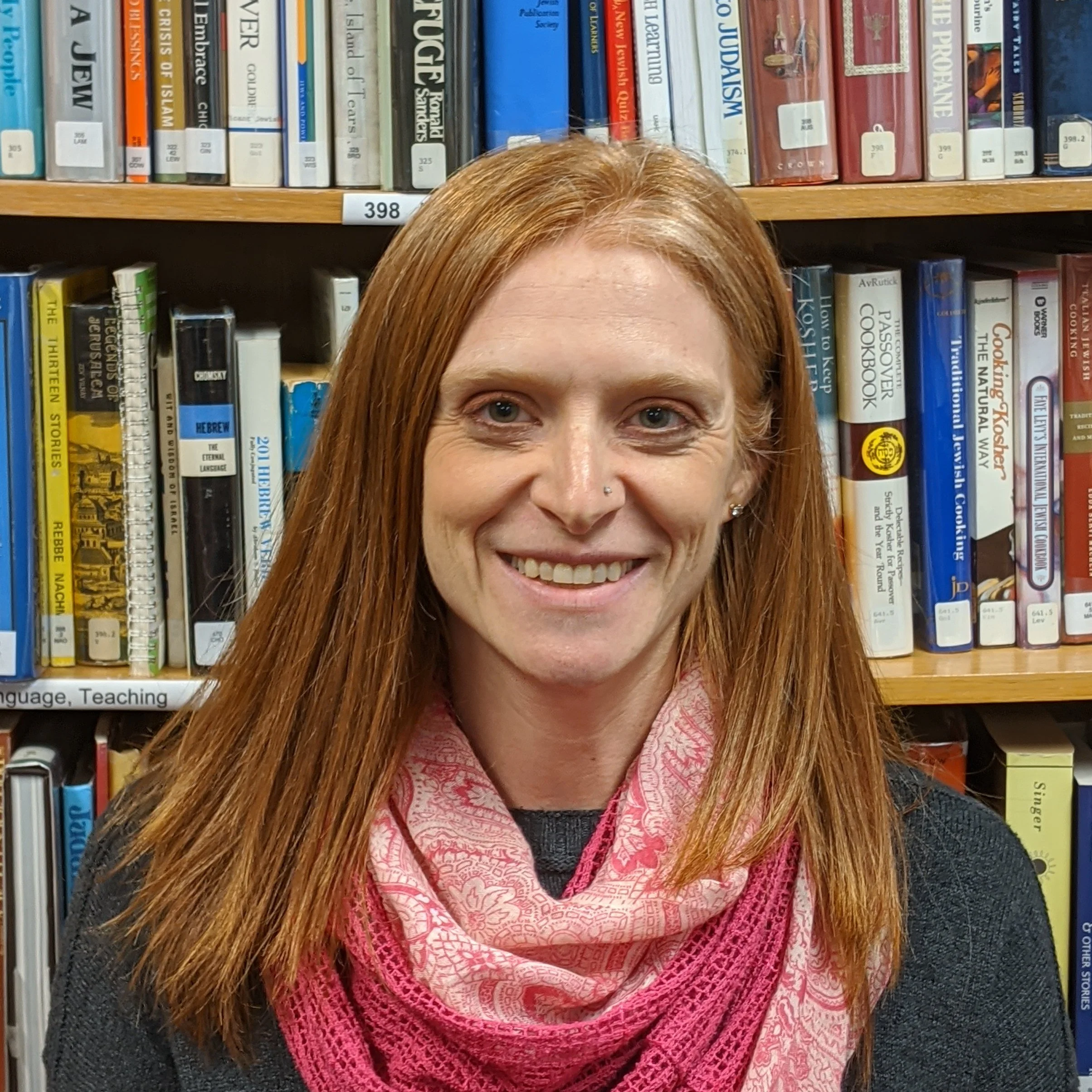
Stacie Gabert, Executive Director
A member of Temple Sinai since 2009 and with two kids in our Religious School, Stacie knows the community well, shares our mission, and is a knowledgeable, welcoming presence in the office. Stacie is a Senior Member of the National Association for Temple Administrators (NATA), a NATA board member, working on her Master's in Jewish Professional Studies, and holds a Certificate in Jewish Leadership. She lives in Milton with her two boys.