
Sermon Parashat Beha’alotcha June 5, 2026 21 Sivan 5786
Rabbi David Edleson Temple Sinai South Burlington, VT
FRANK
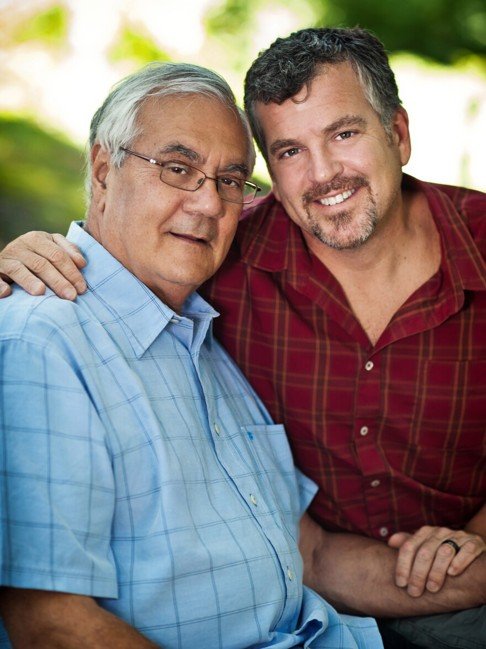
On May 19, Barney Frank passed away at age 86 in the home he shared with his husband in Ogunquit, Maine. We are here tonight celebrating and honoring PRIDE in a synagogue, and so I want share a few words about Congressman Frank and who he was and what he did for the LGBT community.
Frank was born in 1940, in Bayonne, NJ to Jewish parents. His dad owned a truck stop that Frank said was totally corrupt and criminal.
Frank said he grew up in tightknit strong Jewish community. He described his family as not being very religious. “We were very ethnic,” he said, “but I went to Hebrew school and had a bar mitzvah. Growing up and going forward, I recognized a lot of Jewishness: in my taste in food, in my sense of humor and I do have a larger than normal number of Jewish friends than would be statistically expected.”
It was the same year he had his bar mitzvah that he realized he was gay, and immediately knew he couldn’t tell a soul. He decided he would just repress it. It was the 50’s.
Frank managed to get into Harvard. He graduated in 1962 and went right on to get a Ph.D in government and got all his course work done before he left the program to work in politics. Later, he went on to get is law degree from Harvard. Frank was brilliant.
In between degrees, he managed to get elected as a state representative. As a State Congressman, he introduced the state’s first-ever bill proposing legal protections against housing and employment discrimination based on sexual orientation.
In 1980, Frank ran and won election to US Congress representing Massachusettes’ 4th Congressional District that includes Brookline and Newton, where he lived. One of his early campaign featured an iconic ad of Frank in one of his famously crumpled suit looking disheveled, and well, a “schlump,” and the caption read, “Neatness isn’t everything.” He won and kept winning.
Frank quickly got the reputation as the “smartest person in the room.” He was brilliant, had a detailed knowledge of all the minutia of an issue, and was able to see a plan to address the issue. While he was a very liberal Democrat, he also got a reputation as a pragmatist who could work with people across the aisle and other divides to create legislation that could pass.
He also was living life as a more and more openly gay man, so that by 1986, he knew he had to tell Speaker Tip O’Neil because it was only a matter a time until it came out in public. O’Neil said he was sad because he thought Barney might become the first Jewish Speaker of the House.
In 1987, Frank took the unprecedented step of coming out proactively in an interview. When asked if he was gay, Frank answered, “Yeah, so what?” He was the first Congressman to come out. That was less than 40 years ago.
Frank assumed that would be the end of his political career, but he continued to win elections by wide margins. Frank’s quick wit, schlumpy suits and one-line zingers became his signature. But he wasn’t just funny; he was a skilled legislator.
In addition to many bills that aimed to help people who were poor vulnerable, and in need, Frank succeeded in the 1990 Immigration act to get the ban on lesbian and gay immigration removed.
He also became the primary sponsor of the Employment Non-Discrimination Act that sought to prohibit discrimination in employment based on sexual orientation until its passage in 2007.
But it was in 2008, that Frank became a national figure and it had nothing to do with his sexuality. He was chair of the powerful House Financial Services Committee when the 2008 financial crisis hit and Lehman and other banks collapsed. He immediately took the lead in working to craft legislation that would stabilize the economy and also regulate banks more strictly and impose many new consumer protections laws.
The Dodd-Frank Bill is a good way into who Frank was. He was an absolute expert on House Rules and processes. While his genius intimidated a lot of people, Nancy Pelosi loved it. She said, “It’s brilliance that saves time, because he simplifies the complex for us. He is an enormously valuable intellectual resource for the Congress.”
He was also someone who was a pragmatic incrementalist, and was willing to compromise in order to get something better passed even if it wasn’t perfect. While he was a committed liberal his entire life, he was not an idealogue or a zealot. He made friends with people he disagreed with. He used his famous wit and sharp tongue both to destroy enemies and to make friends.
Perhaps the greatest testament to Dodd-Frank was that everyone on both sides of the aisle hated it. The right felt it over-regulated and hurt financial freedom and the left felt it gave far too much to banks. It satisfied no one. There was something in it for everyone to hate.
And honestly, I’ve come to think that’s something we need more of today. People who have strong beliefs but who also recognize that compromise is the key to any difficult legislation. People who don’t let the perfect be the enemy of the good. People who have strong convictions, but among those convictions is a belief that democracies require balancing ideology with practical legislative progress. People that know that being progressive is not about moralistic grandstanding but about making actual tangible progress on the lived needs of vulnerable people in our communities.
When the legislative process breaks down into partisan fighting and litmus tests, people lose faith in democracy. This creates the conditions for the rise of authoritarian and anti-democratic impulses and leaders. There are many “No Kings” protests these days but to not have kings, we have to be able to compromise on legislation. Otherwise democracy dies. Many of us, I fear, are guilty of valuing ideology over compromise, as if the ability to compromise isn’t part of a morality. Too often compromise today is called out as complicity, as selling out, as being corrupt. Sometimes it is, but it is also absolutely required in community life. Seeing politics as a team sport zero-sum game where you totally win or totally lose is as dangerous to the democratic fabric of our lives as authoritarianism. They are two sides of a coin, and while there is plenty of finger pointing to do, at least one of those fingers need to be pointed at the mirror. Moralism, puritanism is a great danger to us; particularly the puritanism that we can’t see because it is ours. That is also the ancient Jewish way of understanding and navigating history.
Barney Frank, love him or hate him exemplifies being a passionate clear advocate AND being willing to make painful compromises.
In 2012, Barney Frank became the first congressman to marry a same sex partner, his partner of 14 years, Jim Ready. Frank was working on his final book when in April of this year, after years of struggling with congestive heart failure, Frank went into hospice care. He called and wrote everyone he knew to tell them he was dying to and say goodbye. The book will not be popular with progressives because in it, he focuses on the dangers of ideological capture by ideologues who push very unpopular policies. Even worse, he writes, is that they convince themselves they are popular, only people don’t know it. America, he writes, is a moderate country and to govern means understanding that, not denying it.
Frank was still asking for book recommendations the week before he passed in the home he and Jim shared in Ogunquit.
May his memory be for a blessing.
